
The strongest product story is a real result you can inspect. This Hotel Lobby AI case study follows two actual website-generated Duo videos: the same original pair of portrait subjects, the same orange-booth concept, and two different performance briefs.
The creative goal was specific. Both performers should retain their own outfits and positions, share one suspended microphone, and exchange the lead during a continuous shot. The later take shows a more readable handoff to the right performer. That makes it a useful demonstration of the studio's central strength: you can edit the direction, create another take, and judge the complete original video.
This is a documented creative iteration, not a controlled A/B experiment. Several prompt details changed together, and no shared fixed seed was recorded. We describe what is visible in these examples without turning two takes into a general success-rate claim.
The brief: two distinct people, one coherent performance
We used the site's original left and right portrait subjects. The left performer wears a dark shirt over a white T-shirt; the right wears a light overshirt over a burgundy top. Those contrasting outfits make the pairing immediately readable against the orange setting.
Both requests used the Duo workflow with MiniMax H3, a requested 15-second duration, 768p, and portrait framing. Both downloaded files measured 768 × 1344 pixels and approximately 15.08 seconds. The samples came through the website's generation, history, and original-download workflow using administrator test credits.
| Creative choice | Shared direction across both takes |
|---|---|
| Subjects | The site's original left and right portrait pair |
| Stage | Orange backdrop and one suspended microphone |
| Camera intention | One continuous, fixed shot |
| Wardrobe intention | Separate, consistent outfits |
| Performance intention | Left performer opens; right performer takes a later lead |
| Current generation quote | 10 credits per attempt |
The constant creative target makes the comparison useful. It does not isolate the effect of a single prompt sentence.
Take one: strong visual identity, a less distinct handoff
The first output establishes the orange stage, a suspended microphone, and a pair with clearly different outfits. It already has an immediate, recognizable visual character.
The part that needed a stronger creative direction was the exchange. Across the first take, the left performer remains dominant; the requested later handoff is less clear. That is a specific observation with a specific next step: make the lead and listening roles more explicit.
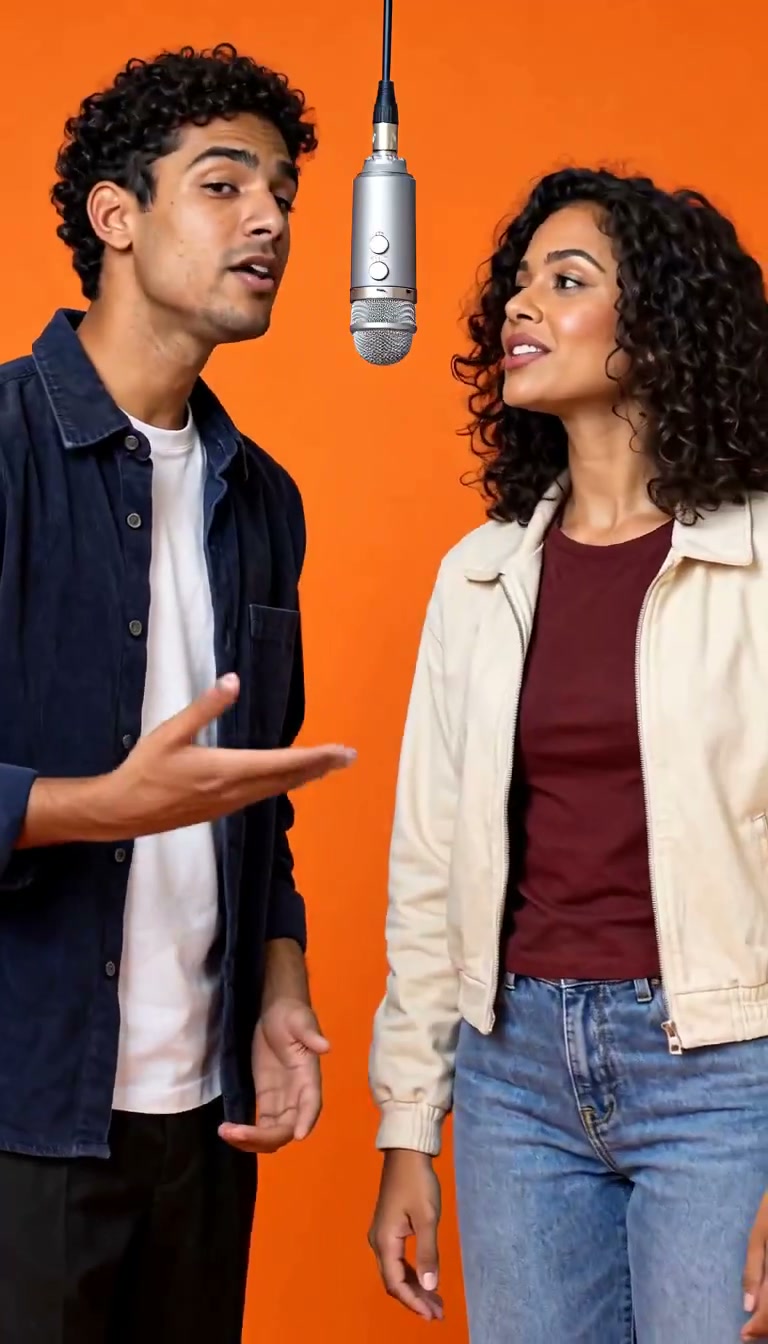
Take one at 11 seconds. This is an unretouched frame from the original website-generated video; watch the clip to judge the full exchange.
The complete first take, approximately 15.08 seconds. Playback starts only when you choose to play it.
The revision: write separate jobs for both performers
The later prompt gave the lead exchange a more explicit structure. It assigned an opening section to the left person, a later section to the right person, and a listening role to whichever performer was not leading. It also asked for low, separate gestures and both faces to remain mostly forward.
The following excerpt captures the revised performance direction used for that request:
Seconds 0–7: the LEFT person performs immediately, with continuous relaxed rap-like mouth movement and one low open-palm gesture; the RIGHT person listens with a closed mouth and small independent nods. Seconds 7–14: the RIGHT person takes the vocal lead and makes one small low gesture; the LEFT listens and nods with a closed mouth.
The full revision also changed framing language, lighting and background instructions, microphone placement, and audio direction. The first brief requested a silent visual performance; the second requested an original rhythmic groove and non-lexical vocal sounds. Both returned files contain an audio stream, so this case study makes no claim that the silence or sound instructions were followed precisely.
The useful lesson is to give each person a clear job. A broad request for “a great duet” leaves the interaction vague. Lead, listen, respond, and settle are concrete actions you can evaluate after generation.
Take two: a more readable response later in the clip
In the later result, the right performer visibly takes the lead in the second half, with separate low gestures. The change is gradual rather than a frame-perfect switch at exactly seven seconds. The distinct outfits and orange-stage composition still give the pair a strong visual identity.
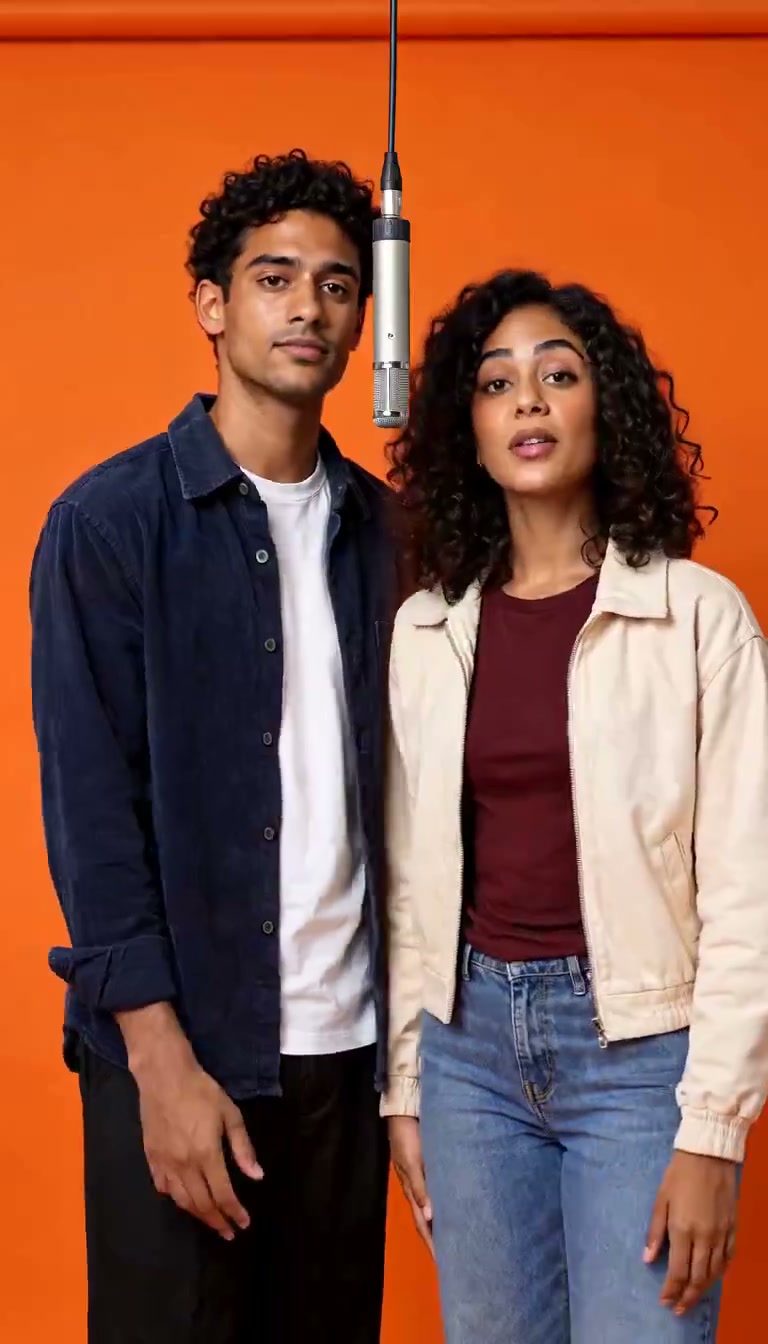
Take two at the same 11-second position. The later lead is easier to read across the moving clip; this still supplies a matching moment for visual comparison.
The complete second take. Compare its later response with the first video's performance.
A horizontal orange bar remains at the top, and the microphone sits close to the left performer's face. Those details matter when reviewing the composition. The meaningful improvement in this pair is the more readable exchange, not a claim that every visual element improved.
Why editable direction is a real advantage
Hotel Lobby AI makes this kind of iteration practical. You can keep the portrait pairing, open the prompt editor, refine the roles, and generate another version. The separate photo slots let you replace or swap a reference when that is the change you actually want. History and original MP4 downloads let you return to the results and compare them properly.
There is a concrete product difference here. HotelLobby.ai's prompt guide describes its current interface as having no free-text prompt box. Our studio exposes an editable prompt. For a creator who wants to direct the opening performer, the response, or the camera brief, that is a decisive control to have. This comparison concerns the documented interfaces reviewed on October 10, 2026, rather than a generation-quality benchmark between the sites.
Turn the example into your own creative process
Choose the relationship first: friends trading the lead, a couple sharing a playful exchange, or two contrasting personalities taking their turns. Assign each person to a photo slot and make the opening and response explicit in the prompt.
Watch the full result. If one specific part misses the idea, choose one major variable for your next attempt. Keep a note of the prompt and the result you preferred. Our two-take example changed several instructions together; a more focused next iteration can make your own review easier.
A vivid stage. Distinct performers. Direct creative control. Real videos you can compare. That is the compelling package Hotel Lobby AI puts in your hands. Read the prompt guide, explore Solo versus Duo, and give your own pairing a confident performance brief.